Stress is a word we use for many different things. A deadline is stress. A diagnosis is stress. Being cut off at a roundabout is stress.
But in the research behind this program, stress has a narrower meaning. That narrower definition is what makes it useful.
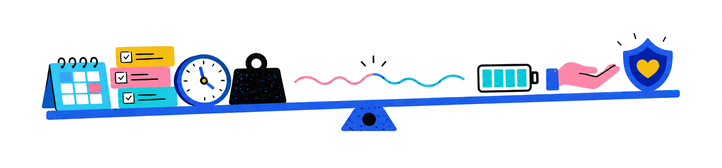
Stress is not simply something that happens to you. It is “an imbalance between demands and resources.” The model used across much of occupational health psychology also makes it clear that stress “stems from the person or the environment as well as the interaction between the two.”
It is not only about the event. It is not only about you. It is about the relationship between the two.
That relationship is shaped by two quick judgements, both of which often happen without you noticing.
- What is this? The first judgement “consists of an evaluation of whether the event is a threat to individuals’ well-being or whether they can dismiss it as benign or perhaps challenging.” In simpler terms, is this a threat, something harmless, or a challenge I can take on?
- What have I got? If the event feels threatening, a second judgement follows. During this stage, “individuals evaluate their available options for coping with the stressor.” In other words, what can I realistically do in this situation, using the resources I have?
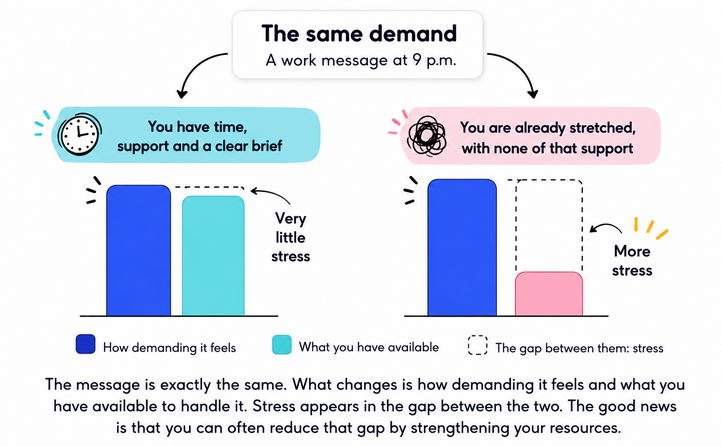
Stress tends to appear when the answer to the first question feels big and the answer to the second feels small.
It lives in the distance between those two answers: how demanding does this feel, and what resources do I have to deal with it?
There is some good news in that. A gap has two sides, and the side you can usually influence is the second one.
This helps explain why the same event can affect two people very differently. It also explains why something may affect you differently in March than it did in January.
A message from your manager at nine in the evening is the same demand in both cases. If it arrives during a week when you have enough time, support, and a clear understanding of what is expected, it may be only an irritation. If it arrives during a week when those resources are missing, it may cost you the entire evening.
The message has not changed. What has changed is the balance between the demand and the resources available to you.
This does not mean the pressure is imaginary. Demands are real, and they are often unreasonable. No change in perspective can make an unmanageable workload workable.
What this model gives you is another place to look. If stress exists in the gap between demands and resources, that gap can be reduced from either side. This program focuses mainly on the side you are more likely to influence: what happens between a demand arriving and your response to it.
Think about the pressure you are under right now. Which side of the gap feels bigger?
Nothing is recorded, and there is no right answer.
It is also important to be honest about what this program can achieve.
The most thorough review available included 117 studies and more than 11,000 people. It found that individual stress-management programs had small to moderate effects. However, the certainty of these findings was rated as low.
When researchers looked specifically at digital workplace programs, the average effect was even smaller. Many of those studies also had serious design problems.
This is the smallest claim anything in this app makes. Hold it loosely.
There is, however, one genuinely encouraging finding about this format.
For stress in particular, self-guided programs like this one have been compared directly with coached programs. The results showed no significant difference between them on any measured outcome.
That is unusual. It suggests that completing this program on your own is not a second-best option.
The main advantage of guidance was that more people finished the material when they received coaching. So the most useful thing you can do to improve your own chances is also the least glamorous: keep going.