

What normal sleep actually looks like
You are not failing to meet a perfect standard. Sleep happens in cycles, waking during the night is normal and eight hours is an average, not a rule.
Much of the distress surrounding insomnia comes from comparing your nights with an unrealistic picture of sleep: eight uninterrupted hours, falling asleep within minutes and noticing nothing until morning.
Many people do not sleep that way. Believing that they should can make an ordinary night feel like a failure.
Sleep is not a single state. During the night, you move several times through cycles that last roughly 90 minutes. These cycles include light sleep, deep sleep and dreaming sleep, arranged in a pattern that changes as the night progresses.
Most deep sleep occurs during the first half of the night, while dreaming sleep becomes more common during the second half. This means the earlier and later parts of the night do different things. Losing sleep at the beginning of the night is not the same as losing it near morning.
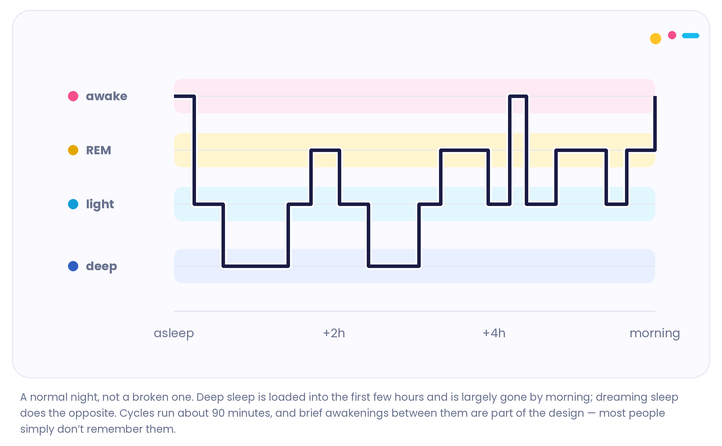
Waking during the night is normal. Brief awakenings are an expected part of ordinary sleep. People who generally sleep well experience them too.
This matters if you have been treating every nighttime awakening as proof that something is wrong with your sleep. Waking up is not necessarily the problem. What happens after you wake up is often what keeps you awake, and that is something this program can help you change.
The amount of sleep you need varies. Sleep needs differ from one person to another and can change throughout life. Some adults function well with six hours, while others need nine. Eight hours is an average, not a requirement or a target you are failing to reach.
There is one more important point. People experiencing insomnia often estimate that they slept less than they actually did.
Time spent awake can feel much longer during the night, and light sleep may feel like being awake. Your diary may therefore underestimate how much you slept. This is expected, and the method already takes it into account.
Do not try to correct your estimates, and do not treat this as a reason to distrust your diary. Simply record what you remember as accurately as you can.
This is what a normal night can look like. Lesson 3 considers a more difficult question: if your sleep system is not broken, what keeps the difficult nights going?