

What recovery actually needs
Not working is not always the same as recovering. Recovery has four different parts, and most evenings only give us one or two of them.
An evening on the sofa with your phone is not work. But for many people, it is not really recovery either. That difference can help explain why even several nights of going to bed early do not always leave you feeling more rested.
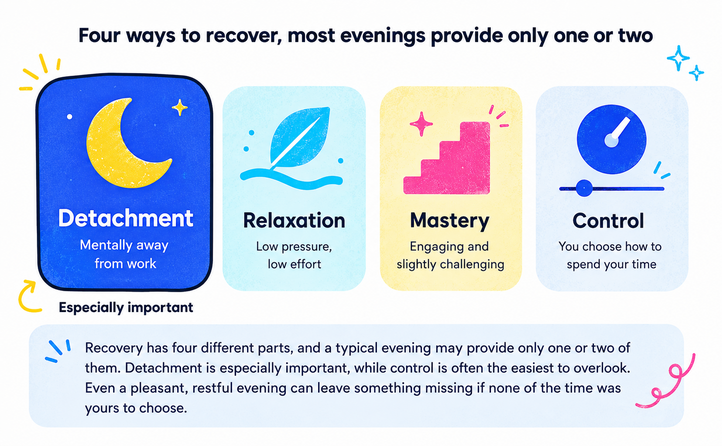
Research identifies four main recovery experiences, and each plays a different role.
- Detachment, being mentally away from work. This is one of the most important recovery experiences and the focus of the previous three lessons.
- Relaxation, activities with little pressure or effort. A walk, listening to music, taking a bath or simply sitting outside. It may look similar to distraction, but it is not quite the same thing.
- Mastery, doing something engaging and slightly challenging that is not related to work, such as learning a language, playing an instrument, climbing or cooking something new. It requires some effort, but can still help you recover because it gives you a sense of progress and competence in an area where there is less pressure.
- Control, having the freedom to decide how you spend your own time. This one is easy to overlook. An evening can be enjoyable and still offer little recovery if every part of it is organised around other people’s needs.
Now think about a typical evening when you are already exhausted: phone, television, bed. That may provide some relaxation and, if work notifications are off, some detachment. But it provides little mastery and, because scrolling is mostly reactive, often less control than it seems.
So the problem may not be that you are recovering badly. You may simply be relying on only one or two parts of recovery and then wondering why rest does not seem to be enough.
The answer is not to fill every evening with activities. That would simply turn recovery into another list of things you have to do, creating the same demands problem we discussed in Lesson 2.
Instead, notice which part of recovery is missing and add one small thing. Often it is mastery or control. It might only take twenty minutes. And it is often something you used to enjoy but gradually stopped doing.
Control deserves particular attention because it is easy to dismiss, even though it may be the thing that has disappeared most. An evening can be calm, pleasant and spent with people you care about, but still offer very little control if none of it was yours to decide. This is especially relevant if you have caring responsibilities, where your personal time can feel just as scheduled as your working day.
If that sounds familiar, the useful question may not be how to rest more. It may be whether there is any part of your week that is yours to choose. Even twenty minutes that you decide how to spend can make a difference.
Mastery can feel less intuitive when you are exhausted. You may think, I don’t have the energy for a hobby. That is understandable. The point is not to take on a major commitment or an evening class. A short, engaging activity that holds your attention can be enough. What matters is that it gives your mind somewhere else to go instead of continuing to replay the working day.
Before this unit ends, there is one more thing to check. What your check-ins show places your two daily numbers side by side and shows how often your recovery score was zero. You can find it on the Tools page next to the daily check-in. If you have been checking in for about a week, you should now have enough entries to start seeing a pattern. Whatever the result looks like, it is based on your own days rather than a guess, giving you a clearer view of the balance this unit has been exploring.