
What burnout actually is
Burnout comes from work stress, not from a personal failing, and that distinction matters.
People use the word burnout to describe all kinds of things, a difficult couple of weeks, a bad manager, or simply feeling tired in the middle of the week. So it helps to start with the actual definition. It is narrower than the way we use the word in everyday life, and that makes it more useful.
The WHO defines burnout as “a syndrome conceptualised as resulting from chronic workplace stress that has not been successfully managed.” There are two important points in that definition. Burnout is specifically linked to work, and the WHO states that the term “should not be applied to describe experiences in other areas of life.” It is also not a medical illness. Burnout is classified as an occupational phenomenon, not a medical diagnosis.
Why does that distinction matter? First, it shifts the focus away from you as a person. Burnout is connected to the conditions around your work, not to a personal flaw. Second, it gives us an important boundary that we will return to in Lesson 4. If that sense of heaviness has spread beyond work and into every part of your life, it may be something other than burnout, and that may need a different kind of support.
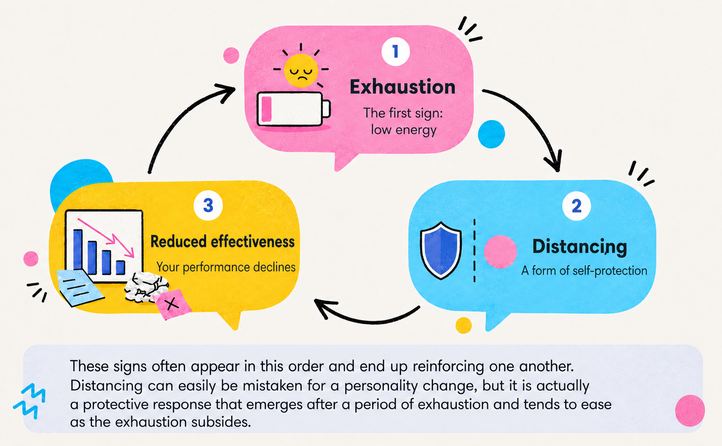
Burnout has three dimensions, and they often develop in this order.
- Exhaustion. Feeling physically or emotionally drained, or both. This is usually the first sign and the one people notice most easily.
- Distance. Pulling back from work, often with a sense of cynicism or why bother. It can feel like a change in personality, but it is not. It is often a protective response that appears after exhaustion has been building for some time.
- Feeling less effective. The sense that your work is not going as well as it used to, that you are slower, less capable, or less effective. That feeling is exhausting in itself, which is how the three dimensions begin to reinforce one another.
There is also an important limitation to keep in mind: there is no single agreed test for burnout and no universally agreed cut-off point. On the same questionnaire, simply changing the threshold can shift the proportion of people classified as positive from around 44% to 21%. Around 40–50% of the disagreement between studies comes from that one choice.
That is why this program will not give you a burnout score. Not because it would be impossible. Validated questionnaires exist, and some are free to use. But a severity category based on a threshold that experts do not fully agree on can look more definitive than it really is.
Instead, you will track something that can change from day to day: how much energy your day used, compared with how much you were able to recover. Think of it as a balance, not a grade.
One important note before you start. Self-guided programs like this one can help, but they tend to help less than working directly with a person. There is also a broader point to keep in mind: changing the workplace is more effective than focusing only on the individual. An app naturally focuses on the things you can work on yourself, while Lesson 13 looks at the other side of the picture.