

Demands and resources
Burnout happens when the demands of a job consistently outweigh the resources available to manage them. It is a problem in how the job is designed, not a personal failing.
In Lesson 1, you saw what burnout is. Now let’s look at where it comes from. This program is built around a simple idea, one of the main models used in occupational health psychology.
Every job has demands, the things that use your energy, such as workload, time pressure, emotional strain, conflict, interruptions, and responsibility without control. Every job also has resources, the things that help you manage those demands, such as autonomy, support, clear expectations, feedback, competence, and a manager who reduces pressure rather than adding to it.
Burnout can develop when demands outweigh resources for too long. Not because of one difficult week, but because the balance stays off for long enough that you no longer have the chance to recover.
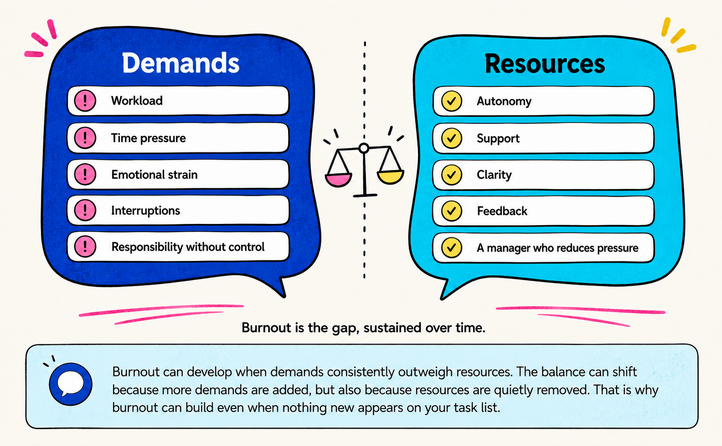
This is, in many ways, a question of balance. Two people can work in the same role for the same number of hours and still have very different experiences. The difference is often not resilience. One person may have more freedom to organise their work, more support, or a manager who steps in and says leave that with me.
Why does this perspective matter? If burnout were simply the result of not being resilient enough, the only solution would be to become tougher. But if burnout develops from an imbalance between demands and resources, there are two sides of that balance to work on, and one of them is about the job itself.
This model also helps explain why burnout can develop so gradually. A new demand is usually easy to notice. A resource that quietly disappears is much harder to see, for example, a colleague who leaves and is not replaced, less autonomy because of a new process, or a manager who used to protect the team from pressure and no longer can. Nothing new has been added to your desk, but the same workload has become harder to carry.
It is worth asking yourself one question: what has been taken away, rather than what has been added? The answer is often found on the resources side, even though we rarely think to count what is missing.
Which demands tend to cost the most? Not always the biggest ones. The most draining demands are often the ones you cannot predict, control, or finish. It might be an interruption that can happen at any time, responsibility without the authority to make decisions, or a task where no one has clearly defined what completion looks like. A difficult week with a clear end can be manageable. A lower level of pressure with no clear boundaries can be much harder over time. The problem is not always the amount of work, but the lack of structure around it.
There is one important thing to keep in mind about the obvious response. When demands outweigh resources, the natural reaction is often to become more efficient, with better systems, earlier starts, and tighter task lists. This can help for a while. But the extra capacity often fills up again, because work with no clear limits tends to absorb whatever capacity becomes available. Efficiency alone does not change the balance, it simply creates more room for additional demands.
If you have been getting steadily better at your job while feeling steadily worse, this may help explain why. The two can happen at the same time. Becoming better at your work can sometimes result in more work being given to you.
So here is the plan. Unit 2 focuses on recovery. Unit 3 focuses on demands. Neither is designed to simply make you tougher, and that is intentional. First, there is one more part of the model to understand, why tiredness can stop disappearing after a night’s rest.