
Building the seam
Detachment becomes easier when the working day has a clear and consistent ending.
Work used to end when you left the workplace. For many people, that boundary is no longer automatic. Work now ends when you decide it does, which can make it much harder to fully switch off.
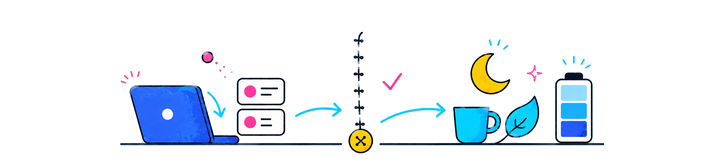
The answer is not more discipline. It is a clear transition between work and personal time, so switching off becomes part of a routine rather than another decision you have to make when you are already tired. This lesson builds that transition in a few simple steps.
The first is a closing ritual, five minutes at the end of the working day, repeated in the same way each time. Consistency matters more than the exact routine. A useful closing ritual has three parts:
- Close the day. Take a quick look at what you completed. This is not about evaluating your performance, it is simply a way to bring the working day to an end.
- Prepare for tomorrow. Write down the two or three things that need your attention next. This gets unfinished tasks out of your head and gives you a clear place to continue tomorrow.
- Mark the end. Use a physical signal that work is over, such as closing and putting away your laptop, turning off notifications, taking a short walk or changing clothes. Choose something that creates a clear transition.
The second step is an offline window, a time after which you stop checking work. Choose a boundary you can realistically keep. One hour that you consistently protect is more useful than eight hours that regularly get interrupted by work.
Why choose a specific time rather than simply deciding to switch off? Because a rule like I’ll only check if something is urgent still keeps you mentally available all evening. You have to decide whether something is urgent, and that usually means checking. A clear time removes that decision.
If you work from home, this transition becomes even more important because the physical boundary between work and home is already blurred. Small changes can help. Work in one specific place, put your laptop away when the day ends, and create an activity that separates work from the rest of your evening. Even a short walk can act as a transition between the two.
Phones can make boundaries harder to maintain. If work notifications are always visible, part of your attention remains available to work. A more realistic approach is to turn off work notifications after your chosen time and, where possible, keep work accounts separate from the device you use during your personal time.
Some jobs genuinely make a complete boundary difficult, for example, on-call roles, shift work, teams working across time zones or running a business alone. If that applies to you, do not create a boundary you know you cannot keep. Make it specific and realistic instead. You might be available on particular evenings but not others, or choose one set time to check messages rather than checking throughout the evening. A smaller boundary that you can maintain is more useful than a larger one that is repeatedly broken.